
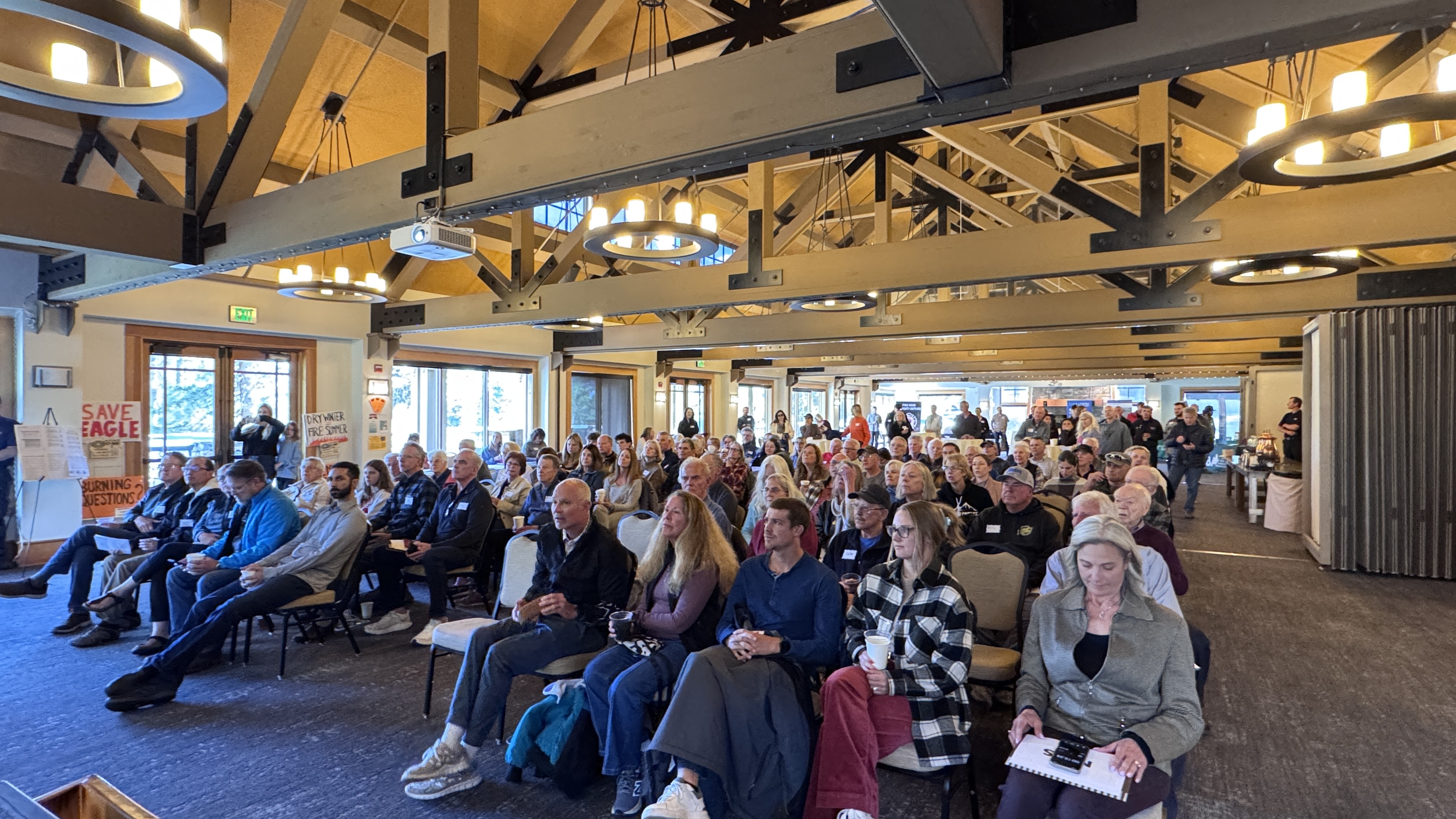
Residents, local agencies, insurance professionals, and wildfire mitigation experts gathered at The Chateau this week for a Wildfire Preparedness & Mitigation Community Seminar focused on one increasingly urgent question: what can homeowners do now to better protect their properties and neighborhoods before wildfire season intensifies?
The event brought together speakers from the North Lake Tahoe Fire Protection District (NLTFPD), Tahoe Resource Conservation District (Tahoe RCD), local insurance representatives, community advocates, and wildfire mitigation specialists to share practical, actionable information residents can begin implementing immediately.
The evening underscored a growing reality across the Tahoe Basin: wildfire preparedness is no longer optional. It is becoming an essential part of homeownership, insurance eligibility, and long-term community resilience.
The “Worm” Project: Building a Wildfire Buffer Above Incline Village
Jason Furmaniak, Forester for the North Lake Tahoe Fire Protection District (NLTFPD), presented an update on the district’s large-scale wildfire mitigation effort known as “The Worm” – sometimes playfully referred to as “Wally the Worm.”
The Worm Project is designed to create a more intensely managed forest buffer around neighborhoods located above Highway 431 in Incline Village. The project area begins at the boundary of private property and extends approximately 132 feet deep onto IVGID-owned land, stretching even farther into IVGID property in some locations as it wraps around residential neighborhoods.
The goal of the project is to reduce wildfire intensity and improve defensible space protections by creating greater separation between understory vegetation and removing smaller, suppressed trees that can contribute to ladder fuels and fire spread.
Furmaniak emphasized that the work is not intended to clear-cut the forest or dramatically alter the natural landscape. Approximately 10–15% of native brush cover will remain in a mosaic pattern throughout the project area to help preserve the forest’s natural appearance, sustain wildlife habitat, maintain soil stability, and protect water quality.
Phase One of the Worm Project covered 62.6 acres and was completed in July 2025. That phase was funded entirely by IVGID.
Phase Two, which will cover an additional 105.8 acres, is scheduled to begin in July 2026 and conclude by August 2026.
Funding for Phase Two comes from multiple sources, including:
- A Nevada Shared Stewardship Grant through the Nevada Division of Forestry under the A.B. 578 Better Together Nevada Shared Stewardship Program, with IVGID providing a 10% funding match for approximately 94.9 acres of treatment work
- A Hazardous Fuels Community Protection (HF-CP) grant from the U.S. Forest Service, administered through the Nevada Division of Forestry, with IVGID providing a 50% funding match for approximately 10.9 acres
The presentation highlighted both the scale and complexity of wildfire mitigation efforts already underway in Incline Village, while reinforcing the importance of sustained funding, long-term forest management, and continued community support.
While large-scale forest management projects help reduce wildfire intensity around the community, speakers emphasized that individual homeowners also play a critical role in wildfire preparedness.
Defensible Space: What Residents Need to Know
Ryan Dominguez, Fuels Mitigation Specialist, from the North Lake Tahoe Fire Protection District emphasized that defensible space starts immediately around the home.
The presentation focused heavily on ember resistance and the importance of creating spacing between vegetation, particularly in the first five feet surrounding structures.
Residents learned about:
- Immediate ember-resistant zones
- Proper vegetation spacing
- Tree limb clearance
- Reducing combustible materials near homes
- Maintaining access routes for firefighters
Several attendees were surprised to learn that embers, not flames, are often responsible for home ignition during wildfires.
For homeowners wondering where to begin, the North Lake Tahoe Fire Protection District offers free defensible space inspections. During these inspections, staff walk the property with homeowners and provide practical guidance on the steps that can help give a home a better chance of surviving a wildfire.
Schedule a defensible space inspection here: Make an Appointment
Another highly recommended resource shared during the seminar was the Tahoe Living With Fire website, which includes extensive free educational materials for residents.
Start here: the Defensible Space Resource Guide walks homeowners through practical actions they can begin taking immediately to reduce wildfire risk around their property.
Residents are also encouraged to create and regularly review an evacuation plan before wildfire season intensifies.
The overall message from the presentation was clear: small, proactive steps taken now can make a meaningful difference in helping protect homes, neighborhoods, and first responders during a wildfire event.
What It Means to Become a Fire-Adapted Community
Wildfire preparedness is often discussed using terms like “Fire Adapted Community” and “Firewise USA®,” but the two are not interchangeable. One describes the broader goal, while the other is a nationally recognized program designed to help communities work toward that goal.
A Fire-Adapted Community (FAC) is a neighborhood where residents understand wildfire risk and actively work together to reduce it. That includes:
- Creating defensible space
- Home hardening against embers
- Improving evacuation readiness
- Reducing hazardous vegetation
- Building a culture of preparedness
In mountain communities like Lake Tahoe, becoming fire adapted means recognizing that wildfire is part of the natural environment and learning how to safely live with it rather than simply reacting during emergencies.
Kelsey Stalker from the Tahoe Resource Conservation District (Tahoe RCD) explained that neighborhoods and HOAs are encouraged to begin by becoming more fire adapted with support from organizations like Tahoe RCD and NLTFPD.
That process can help communities organize and gain access to valuable resources such as:
- Defensible space inspections
- Year-round chipping services
- Educational programs and materials
- Neighborhood cleanup support
- Wildfire mitigation planning assistance
- Technical guidance for homeowners and HOAs
Firewise USA®, meanwhile, is a formal national recognition program administered by the National Fire Protection Association (NFPA). The program provides a structured framework for neighborhoods to organize wildfire preparedness efforts and document the work they are doing to reduce risk.
Communities pursuing Firewise USA® recognition typically:
- Form a neighborhood committee
- Complete a wildfire risk assessment
- Develop an action plan
- Host annual educational activities
- Track community investment in mitigation work
In simple terms:
- Becoming “fire adapted” is the ongoing process of building wildfire resilience
- Becoming “Firewise USA® recognized” is an official designation acknowledging a community’s organized preparedness efforts
Firewise recognition is an important milestone, but long-term resilience requires ongoing participation, fuels reduction, home hardening, and continued neighborhood engagement.
Many communities also pursue Firewise USA® recognition because it can help demonstrate proactive mitigation efforts to insurance providers and may support long-term insurability in high fire-risk areas.
Wildfire preparedness works best when neighborhoods organize together.
You can see her whole presentation here:
Neighbors Helping Neighbors: Building a Fire-Adapted Community
One of the most personal and community-focused presentations of the evening came from Incline Village resident Tom Millhoff, who shared how residents in the Upper Tyner neighborhood have worked together over the past several years to become both a Fire Adapted Community and a Firewise USA® recognized neighborhood.
Millhoff explained that living in a “halo neighborhood” surrounded by forest on multiple sides made wildfire risk feel very real. After learning more about available wildfire preparedness programs in 2021, he began working with neighbors, the North Lake Tahoe Fire Protection District, and Tahoe Resource Conservation District to organize Upper Tyner around wildfire mitigation and preparedness efforts.
His message throughout the evening was simple: protecting homes from wildfire requires neighborhoods to work together.
“The biggest fuel risk to your house outside your house is your neighbor’s house,” Millhoff explained while discussing how fires can spread rapidly through residential neighborhoods during ember-driven wildfire events.
Millhoff encouraged residents to start by scheduling defensible space inspections and walking properties with fire officials to better understand vulnerabilities around their homes. He emphasized that even homeowners who have done significant mitigation work still benefit when neighboring properties also participate in wildfire preparedness efforts.
Beyond mitigation work itself, Millhoff highlighted how wildfire preparedness can also strengthen neighborhood connections and community engagement.
Upper Tyner residents have organized wildfire-focused block parties, educational gatherings, and door-to-door outreach campaigns to encourage participation and build awareness. He shared practical advice for other neighborhoods hoping to pursue Firewise USA® recognition, including:
- Organizing neighborhood socials or wildfire block parties
- Using flyers, QR codes, and online invitations to increase participation
- Going door-to-door to engage neighbors personally
- Forming small Fire Safe Councils to help distribute the workload
- Working closely with Tahoe RCD and NLTFPD throughout the process
Millhoff also spoke about the benefits communities can experience when they become proactive and organized around wildfire preparedness. In Upper Tyner, those efforts helped support additional fuels reduction work and coordination with agencies working on projects like the Worm Project.
Another key point from his presentation was that wildfire preparedness is not solely about compliance or certification. It is about reducing ignition risk, improving neighborhood resilience, and helping communities become safer and potentially more insurable over time.
“If you’ve ever thought about wanting to do a little bit more community service, I would encourage you to think about trying to form a fire safe council,” Millhoff said. “It’s something we all care about together.”
His presentation reinforced one of the strongest themes of the evening: wildfire preparedness is most effective when neighbors work together long before an emergency occurs. You can see his whole presentation here:
Insurance Challenges Continue to Evolve
Insurance availability and affordability are top of mind across Tahoe, particularly as more homeowners face rising premiums, stricter underwriting standards, and non-renewal concerns.
Britney Bladel from State Farm and Michael Peyton from Peyton Insurance discussed how insurers are increasingly evaluating:
- Defensible space compliance
- Roofing materials
- Vegetation management
- Access routes for emergency response
- Overall home hardening efforts
They also highlighted the growing importance of standards established by the Insurance Institute for Business & Home Safety (IBHS), which focuses on wildfire-resistant construction and mitigation practices.
One of the most significant concerns discussed involved aging condominium and townhome communities throughout Incline Village and Crystal Bay. Many of these complexes are now more than 50 years old, creating increasing concern for insurance carriers evaluating long-term risk exposure.
Some carriers are now requiring major infrastructure upgrades in order for communities to retain or secure coverage. These improvements may include:
- HVAC system modernization
- Updated electrical wiring
- Plumbing upgrades
- Roofing improvements
- Other deferred maintenance and life-safety infrastructure updates
Attendees were encouraged to begin communicating with insurance providers earlier in the process of securing or renewing coverage, proactively document wildfire mitigation work completed on their properties, and work collaboratively within HOA communities to address long-term maintenance and wildfire preparedness needs before insurance challenges become more severe.
The discussion reinforced an important message for Tahoe homeowners: wildfire preparedness and home hardening are no longer only about fire safety. They are increasingly tied to long-term insurability, property values, and financial resilience. to long-term insurability, property values, and financial resilience.
Community Participation Remains Critical
Throughout the evening, speakers emphasized that wildfire preparedness is most effective when communities work together.
The event also highlighted the importance of taking advantage of existing programs and funding opportunities, including the Good Neighbor Program, which assists homeowners with paperwork and support for wildfire fuels mitigation work funded through the U.S. Forest Service.
Kristie Wells, a realtor who organized the seminar, encouraged residents to continue learning, ask questions, and utilize the educational materials and local resources available.
“The goal is to help people leave with practical information they can actually use,” Wells said during closing remarks. “Preparedness starts long before an emergency.”
The strong turnout demonstrated growing community interest in wildfire resilience and highlighted the importance of continued collaboration between agencies, residents, HOAs, and local businesses.
Key Wildfire Preparedness Resources
- Living With Fire Resource Guide. A comprehensive homeowner guide covering defensible space, evacuation planning, ember resistance, landscaping, and wildfire preparedness.
- Create and regularly review an evacuation plan before wildfire season intensifies.
- North Lake Tahoe Fire Protection District – Worm Project. Information about fuels reduction efforts, defensible space requirements, and wildfire mitigation programs.
- North Lake Tahoe Fire Protection District – Make an Appointment. Schedule a defensible space inspection to better understand potential concerns around your property and the steps you can take to reduce wildfire risk.
- Tahoe Resource Conservation District. Programs, defensible space inspections, chipping services, Firewise USA support, and wildfire preparedness resources.
- Firewise USA Program. Learn how neighborhoods can organize and become recognized Firewise communities.
- Insurance Institute for Business & Home Safety (IBHS). Information on home hardening and wildfire-resistant construction practices.
Home Hardening Products and Services
Several local businesses and wildfire mitigation specialists supported the seminar and were available to answer questions, share resources, and discuss products and services designed to help homeowners reduce wildfire risk.
Attendees are encouraged to learn more about the following companies and the solutions they provide:
- Wildfire Pro Shop. Wildfire mitigation products and defensible space solutions.
- Fire Hard Property Defense. Home hardening and wildfire risk reduction services.
- Evolution Framing / Fortress Building Products. Specializes in interlocking steel deck framing, joist, and ledger systems designed to create more durable and fire-resistant outdoor structures.
- Capital Lumber / TimberTech. Distributes specialty building materials, including TimberTech composite decking products designed for durability and lower maintenance in wildfire-prone environments.
We would also like to extend our sincere thanks to the Incline Village Enhancement Fund and IVCBA for their support of this event. Their commitment to community education played an important role in helping make this seminar possible.
As wildfire risk continues evolving across the Tahoe Basin, the seminar made one thing clear: preparedness is no longer just the responsibility of fire agencies. From homeowners and HOAs to insurers, contractors, and local organizations, protecting the community will require ongoing participation, education, and action long before smoke appears on the horizon.